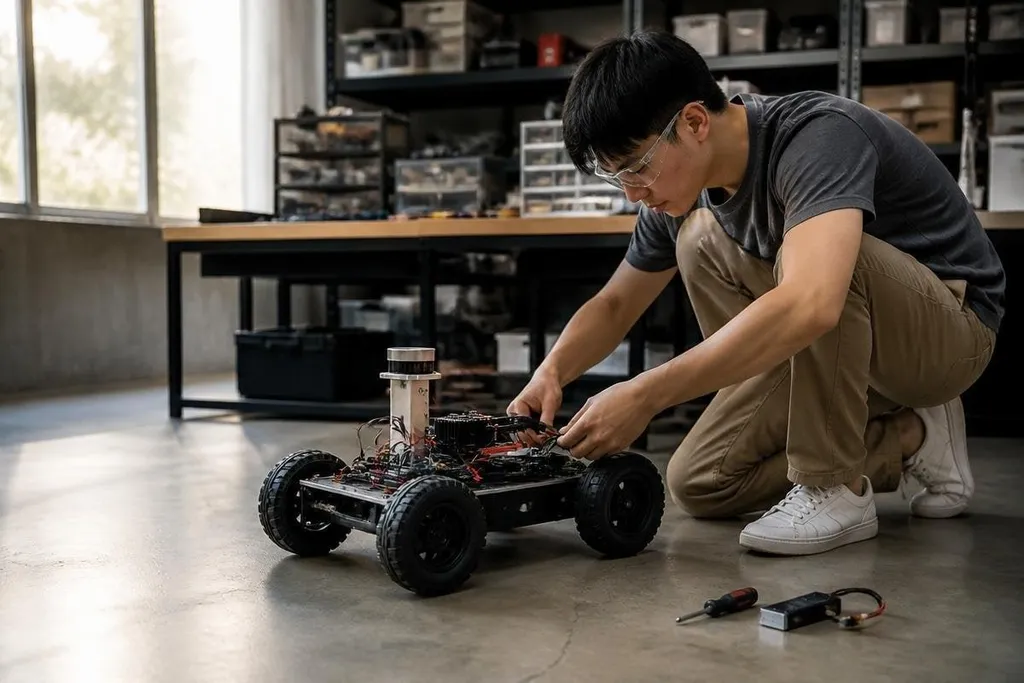
A robot can move across a room with a small set of parts: a controller, motors, sensors, and software. The harder work starts when those parts must keep working after a loose cable, a weak battery, or a bad reading from one sensor.
Makers are helping robotics move ahead by testing these small systems in public, changing designs quickly, and sharing what fails. Their work matters to anyone deciding which ideas deserve more time and money.
- Open hardware lowers the cost of trying a new design.
- Shared software lets one fix reach more than one robot.
- Failed builds expose problems that polished demos can hide.
The useful work happens between parts
A maker project rarely depends on one clever component. A servo motor may have enough torque to lift a gripper, but the controller still needs to stop the motor at the right point. A camera may see an object, but the software must turn that image into a safe movement.
That connection is where many projects gain value. Makers can change the bracket, rewrite a control loop, or move a sensor without waiting for a large product team. Each change gives them a clearer answer about what works.
Open tools help with this process. ROS 2 can connect sensors, controllers, and robot software, while CAD files let a maker change a physical part before printing it. A microcontroller can then handle a narrow task, such as reading an encoder or controlling a motor.
The result is less polished than a showroom demo. It can be more useful, because the build record shows the parts that needed repair.
Fast changes reveal the real limits
A robot that works once has passed a small test. A robot that repeats the same task has started to answer a useful engineering question. Makers often focus on that repeatability because they can test one change at a time.
A gripper may pick up a rigid box and fail on a soft bag. A wheeled robot may run well on a clean floor and lose position near a ramp. A LiDAR sensor may map a room correctly, while reflective surfaces produce poor readings.
Those limits decide where a robot can work and how much setup it needs. They also show when a person must watch it. Robot24.com robotics coverage reports on machines and projects with these details, so you can judge whether a system is ready for work beyond a test site.
The strongest maker work keeps the test narrow. It names the task, records the failure, and changes one part before running the test again. That method gives other builders something they can check instead of a claim they must accept.
Sharing turns one fix into many tests
A shared design can save another maker from repeating the same wiring mistake. A public code change can fix a sensor problem for several robot types, provided the hardware and software match.
Sharing also puts pressure on unclear claims. A build that includes its parts list, wiring diagram, software version, and test conditions gives people a way to repeat the result. Missing details make that work harder.
This does not mean every open project will become a product. Many remain teaching tools or proof that one task can be done under narrow conditions. That still has value when the limits are stated clearly.
I'd back maker projects that show repeat tests and repair steps over projects that show one smooth video.
A practical check before you copy a build
Use this list before spending money on parts or time on a new design:
- Name the task: Write down the one movement or job the robot must repeat.
- Check the input: Confirm which sensor supplies each decision and what happens when its reading is wrong.
- List the weak points: Mark the battery, cable joints, motors, and moving frames that can stop the build.
- Read the files: Look for the parts list, software version, wiring notes, and test method.
- Plan a stop: Add a physical power cut or software stop before testing near people.
A maker project earns wider use when another person can build it, test it, and see where it fails. The next useful measure is not how smooth the first demo looks, but how many repeated runs the design can complete before a person must fix it.